


 Watch video





 Sign in with Google
YouTube Strategy
YouTube viewer retention: the creator strategy that turns weak performance into watch time


Turning curious clicks into real engagement and long-term YouTube viewer retention requires planning.
Some creators break out early where others upload for months and struggle for every view. It’s not the algorithm choosing favorites. The difference is that one creator thought about the sequence before hitting publish. Successful creators do a few things really well, and that makes all the difference:
- They give viewers a reason to click with a compelling title, thumbnail, and description
- They think about retention, mastering hooks and story loops
- They build momentum to make viewers want more and making it easy to find more)
- They iterate: they don’t waste time on things that aren’t working. They double down on the things that are.
This guide, based on the video for TubeBuddy by creator Scott Simson, focuses on YouTube viewer retention because clicks only matter if you keep people watching long enough for YouTube to keep recommending your video.
Table of contents
- Step 1 – Discovery: finding ideas for videos people want to watch
- Step 2 – Framing: packaging up the idea so viewers want to engage
- Step 3 – Getting the click: master the title + thumbnail combo
- Step 4 – Stick around: earn YouTube viewer retention by leading with payoff
- Step 5 – Keep them engaged: microhooks for max results
- Step 6 – the “binge path”: if you build it, they will come
- Step 7 – double down: Do more of what’s working
- Pre-upload checklist for YouTube viewer retention
- Final thought: YouTube viewer retention is about systems

What’s the big idea?!
Get video inspo backed by data. Next Video Ideas analyzes your channel, audience, niche, and millions of YouTube datapoints to make your next video a #1.
Step 1 – Discovery: finding ideas for videos people want to watch
Most beginners start with topics that sound good to them personally. That makes sense and it’s great up to a point… but too many creators get stuck in this loop.
When you’re small, you need topics with built-in interest. These are the subjects people are already searching for, discussing, and clicking on.
The first part of any good video strategy idea discovery; finding ideas for videos on subjects that people already care about.
Where to find discovery-ready topics:
- Scroll Reddit threads in your niche
- Watch TikTok trends (and the comments underneath them)
- Look at what bigger channels in your niche are posting
- Read comments on videos in your niche (including your own)
Broad categories can work when you find the right sub-angle inside them—like morning routines, productivity hacks, side hustles, and thousands of other “proven popular” ideas.
Step 2 – Framing: packaging up the idea so viewers want to engage
Idea discovery gives you the topic. Idea framing gives you the hook.
Using vague framing is a common beginner mistake. That’s things like:
- “My Morning Routine”
- “Episode 3 of My Journey”
The topics these videos cover aren’t necessarily bad, but they’re definitely poorly framed.
In short: it’s not about you.
Maybe one day, people will want to hear what you have to say just because it’s you saying it. Today is not that day.
You have to make the video relevant to the viewer. These frames give a stranger no reason to care. You haven’t pulled them in.
Instead, reframe the same idea with specificity and stakes.
So instead of “My Morning Routine,” your framing becomes something like “I tried every productivity guru’s morning routine for a week.”
Now the title makes a promise, implies a transformation, and creates curiosity. Viewers don’t need to know anything about you to want to click. And once they click, they’ll get to know you.
Use this checklist to test your next video seed
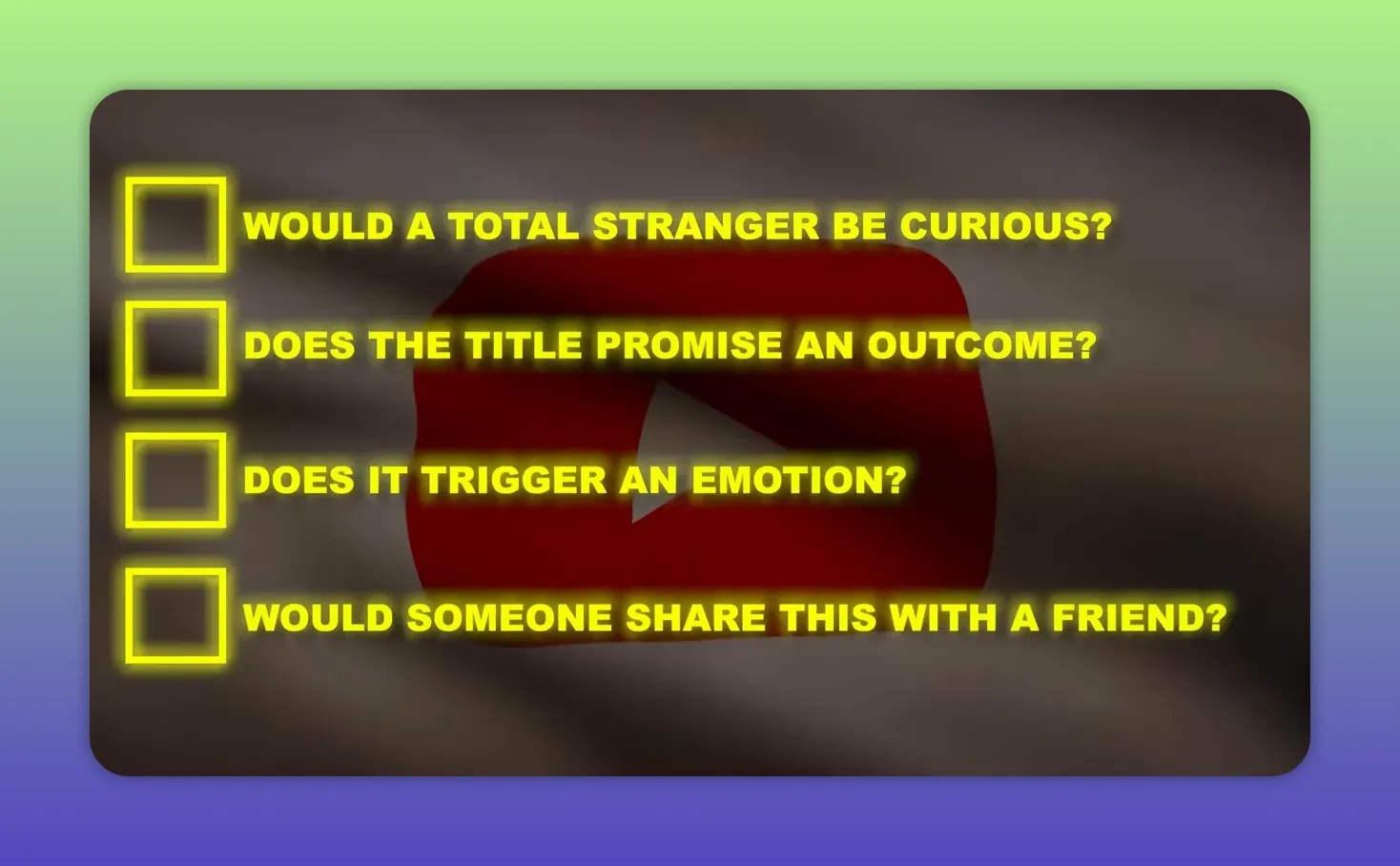
Before you record, run your idea through these questions:
- Would a total stranger understand and be curious about this?
- Does the title promise a specific outcome or experience (not just a broad topic)?
- Does the title + thumbnail trigger emotion—excitement, frustration, surprise, mystery, curiosity, or validation?
- Would someone share this with a friend?
If you can check all four boxes, you’ve planted a strong “seed” for a video.
Key point: if your idea seed is strong, half the work is already done. The other half is getting the click—which we’ll talk about next. Then comes getting viewers to stick around to watch more, which we’ll cover after that.
Step 3 – Getting the click: master the title + thumbnail combo
Even the best idea can flop if people don’t click. Your title and thumbnail should work like a movie poster: they need to make someone stop scrolling and choose your video over dozens of others.
There’s a lot of advice about what makes a good thumbnail but there’s no single formula. Exaggerating emotion, using contrasting colors, keeping text short, sweet, and arresting is good advice but it’s not the whole story.
The real function of a thumbnail is to spark curiosity, then make a promise to pay that curiosity off. Basically, you need to make a viewer stop long enough to ask a question then care enough about the answer to find out.
Three thumbnail tricks that can create curiosity
- Go hyper raw
- Don’t over-edit or over-polishUse real-looking frames and natural lightingAllow slightly imperfect, “pulled from real life” moments
- Lean into stoic or subtle expressions
- Use calm, serious, or “caught off guard” looksSubtle often beats cartoonish shock
- Make sure the thumbnail pays off the title
- If the title says “I survived seven days on $1 a day,” the thumbnail should make viewers wonder if it really happened.
- If the title is a promise, the thumbnail should provide “proof” or visual evidence.
If you want more tactical thumbnail guidance, see optimize your YouTube thumbnail and title CTR on the TubeBuddy blog.
When you lead with the outcome, viewers don’t feel like they’re waiting for the point. They can tell what they’ll get immediately.
Step 4 – Stick around: earn YouTube viewer retention by leading with payoff
Getting the click is great but all the YouTube algorithm really cares about is whether viewers stick around. If you need proof, look no further than the fact that YouTube’s test and compare thumbnails feature only lets you test based on watch time. So the real challenge is keeping viewers watching (i.e. that all-important YouTube viewer retention). This is where creators can really differentiate themselves.
You don’t earn watch time because your video topic is on point, or because your thumbnail and description are a match made in heaven, or because you did the most research into your subject.
You earn YouTube viewer retention by keeping people watching (obviously) and you keep people watching by thinking about your video in 30-second chunks.
Fix your opening: lead with the payoff
Instead of starting with “In this video, I’ll show you…,” you start with the outcome.
“In this video, I’ll show you productivity hacks” does not spark joy curiosity.
Instead, try something like:
“This doubled my productivity last week. Here’s what happened.”
It’s a small change that helps viewers to understand why they should stick around. They’re not waiting for the video to “start,” they’re interested to hear more.
Step 5 – Keep them engaged: microhooks for max results
Payoff gets them in. Microhooks keep them there.
A “microhook” is a tactic that tells the viewer something interesting is coming soon. This creates an open loop which the viewer wants to see closed… and so they stick around.
What microhooks look like:
- “But in a minute, you’ll see why this all makes sense.”
- “And that’s not even the best part.”
Strong creators repeatedly open story loops and close them near the end. That creates ongoing curiosity: viewers watch because they want the answer, the result, or the next reveal.
Retention goal: never let attention run out. You earn attention 30 seconds at a time and the more your video grabs—and rewards—attention, the more reason YouTube has to keep pushing your video.
Step 6 – the “binge path”: if you build it, they will come
Holding attention is powerful, but it’s not the whole growth lever.
The next step is building a binge path.
A binge path isn’t only about end screens or linking videos. It’s about creating consistent formats and a clear channel identity so viewers know what to watch next.
Examples of binge path formats:
- Series-based storytelling (viewers expect a repeatable outcome)
- Recognizable “video world” framing (humor, relatability, or a specific content structure)
- Challenges where the next episode is naturally predictable
Simple way to start:
- Create a recurring series
- Use a repeatable challenge format
- Keep your video framing recognizable in every upload
If someone clicks one upload and immediately knows what the next several videos will deliver, you’ve built a foundation for binge viewing.
Then reinforce it visually: if your thumbnails and titles “belong” to the same world, viewers recognize your channel instantly, even on a crowded homepage.
If you’re working on building longer-term momentum, this pairs well with understanding what viewers replay—because replay often indicates where loops and payoff are working.
Step 7 – double down: Do more of what’s working
Here’s the part that separates random uploaders from strategists: binge paths don’t happen by accident.
They happen when you notice what’s resonating—and you reuse it.
The strategy is called double down.
Your breakout video usually comes with signals from YouTube. Beginners make the mistake of moving on too fast. Smart creators respond by turning signals into more content using the same winning format.
How to find opportunity in your analytics
Look at what’s already working and look for patterns.
- Go to your analytics
- Scroll to your top videos for the timeframe you’re reviewing
- Look for patterns in:
- Series or repeatable formats
- Title structure
- Thumbnail style
Once you spot patterns, bake them into your next videos. That way, new uploads don’t feel random—they feel like a natural continuation of what viewers already respond to.
This is how you move from one view to three views, and from three to 30.
Pre-upload checklist for YouTube viewer retention
- Idea discovery: Are you building from topics people already care about?
- Idea framing: Is your angle specific enough that strangers want the outcome?
- Seed test: Can a stranger understand, be curious, feel emotion, and share it?
- Thumbnail + title: Do they trigger curiosity and match expectations?
- YouTube viewer retention: Does your first 5 seconds deliver payoff?
- Microhooks: Are you opening loops throughout and closing near the end?
- Binge path: Does your channel create a recognizable “what to watch next” experience?
- Double down: Do you reuse what’s working instead of moving on too fast?
Final thought: YouTube viewer retention is about systems
If you want uploads that earn more than a few hundred views, you can’t count on luck. Build the full system:
- Choose ideas with existing interest
- Frame them into a specific, curiosity-driven promise
- Use title + thumbnail to earn the click
- Protect YouTube viewer retention with fast payoff and microhooks
- Create a binge path so one view becomes a session
- Double down on what YouTube signals is working
Do that consistently, and every video has a real chance to take off.
If you want to keep improving your retention-focused strategy, explore more YouTube insights on the TubeBuddy blog, including related guides like video intro and thumbnail expectations.
What’s the big idea?!
Get video inspo backed by data. Next Video Ideas analyzes your channel, audience, niche, and millions of YouTube datapoints to make your next video a #1.
Lead with the payoff in the first seconds (instead of preamble), then use microhooks every 30–60 seconds to open story loops and avoid “attention running out.” Viewers stay when they believe the next moment will resolve something.
Idea discovery is choosing topics people already care about. Idea framing is turning that broad topic into a specific promise, conflict, or outcome that makes strangers want to click.
Not necessarily. The strategy is to create curiosity that makes viewers ask “is this real?” or “is this what I’ll actually get?” Subtle or stoic expressions and authentic raw visuals can work just as well, as long as the thumbnail pays off the title.
A binge path is a repeatable channel identity and format that tells viewers what they’ll get next. When your videos consistently match the same “world,” one watch leads to more watches—turning a single click into multi-video sessions.
Look at your top-performing videos and identify patterns in title structure, thumbnail style, and whether they fit a series or repeatable format. Then reuse those patterns in future uploads so new videos feel like a continuation of what’s already resonating.
Because performance also depends on YouTube’s broader distribution rules and updates. Even strong retention and formats can be affected when the platform changes how discovery works.


