


 Watch video








 Sign in with Google
YouTube Strategy
How to add chapters on YouTube videos and why you definitely should


TL;DR:
- YouTube chapters are indexed by Google and can earn your video a Featured Snippet (appearing above search results).
- To add chapters manually, your first timestamp must be 0:00, and you need at least three chapters in your video description.
- YouTube’s automatic chapters are better than nothing but are unreliable. Manual chapters give you more control and better SEO value.
- Every chapter title is an optimization opportunity: treat them like mini-headlines, not generic section labels.
- TubeBuddy’s Chapter Editor lets you add and edit chapters without switching away from your video, cutting down the time it takes to optimize each upload.
Two minutes. That’s roughly how long it takes to add chapters to a YouTube video. Too many creators skip this simple and important step… and then wonder why their tutorials and how-to videos don’t rank.
YouTube chapters do more than help viewers navigate your content. They’re a direct SEO signal that YouTube and Google both use to understand and surface your video. Skip them, and you’re leaving views, watch time, and search visibility on the table.
Here’s how to add chapters the right way. We’ll run through how to do it manually, automatically (not advised), and finally with TubeBuddy’s Chapter Editor. We’ll detail why the chapter titles you use matters much more than most creators realize.

Get an unfair advantage on YouTube
Give your YouTube channel the upper hand and easily optimize for more views, more subs, and more of every metric that matters.
The SEO value of YouTube chapters
YouTube itself confirms that “chapters help viewers better navigate and enjoy your videos” and that chapters are a signal it uses to surface your content to the right viewers. In other words, chapters aren’t just about helping viewers, they’re about helping algorithms understand your video, which in turn helps you get more views.
It’s a rare win/win/win.
Off YouTube, the benefits are even greater. Videos with chapters are eligible for a Video Snippet on Google — AKA Key Moments feature — which can place your video at or near the top of a search results page. Unlike a standard video result, a Featured Snippet skips the viewer directly to the moment in your video where Google thinks the answer appears. That kind of placement drives real, incremental traffic. And if you answer the viewer’s question, they’re far more likely to engage your content.
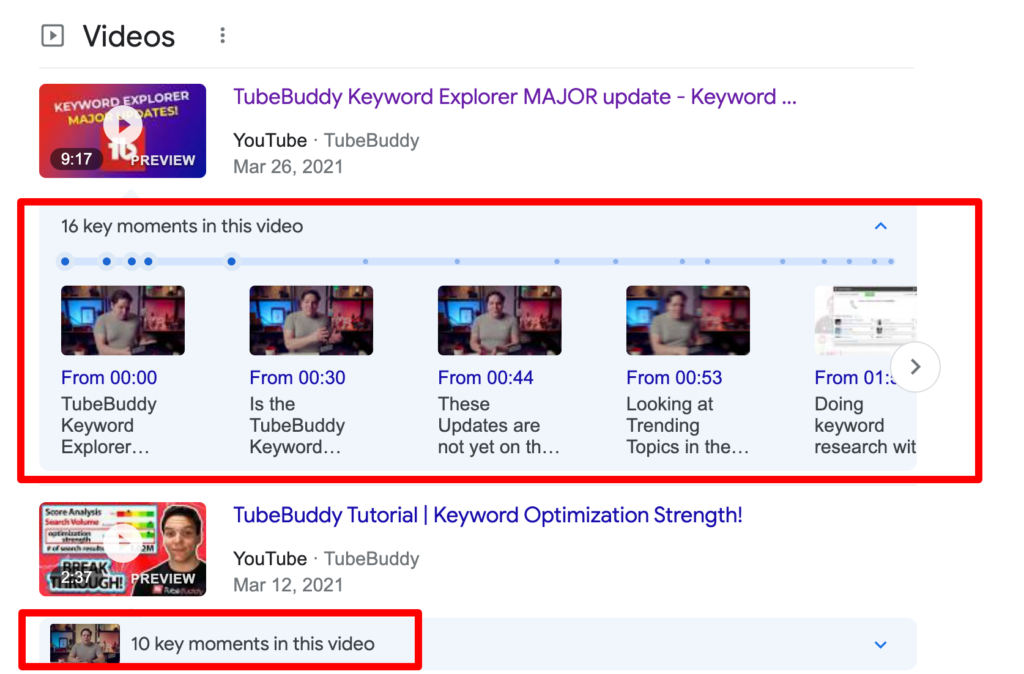
Video Snippets pull mostly from tutorial and how-to content, but every video with chapters is eligible. The point is this: your chapter titles are the primary content that Google pulls from to decide if your video is worth highlighting, .
How to add chapters to a YouTube video
There are two ways to add chapters: manually or automatically. Manual chapters give you more control and are better for SEO. Automatic chapters are faster and better than nothing (and maybe a decent starting point for your manual chapter strategy) but they’re not optimized.
How to format manual chapters
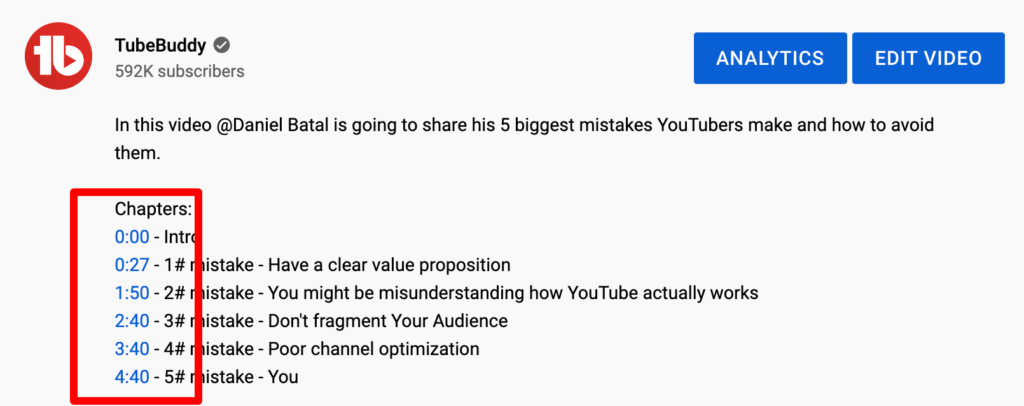
In your video description, create a list of timestamps starting at 0:00.
- Put each new chapter on a new line
- Start with the timestamp (0:00) then a separator (e.g. – or | or —) then the chapter title
Note: the separator is not required… we just think it looks nice - Ensure you add at least three chapters. This is required for them to appear on the video timeline
- Ensure all chapters are at least 10 seconds long
Add your timestamps near the top of your description but not at the top. The first 200 characters of your description do important SEO work, so keep those for your primary keyword and a strong hook. Put your chapter list just below that. For more on how to structure your description, see how to write the best YouTube descriptions for the highest rankings.
Here’s what a formatted chapter list looks like:
0:00 – Introducing the best vegan chocolate cake
1:00 – Why this is the best vegan chocolate cake
2:19 – Ingredients
4:23 – Baking your vegan chocolate cake
5:41 – My secret (vegan) frosting trick
7:01 – Taste test: is this really the best vegan chocolate cake?
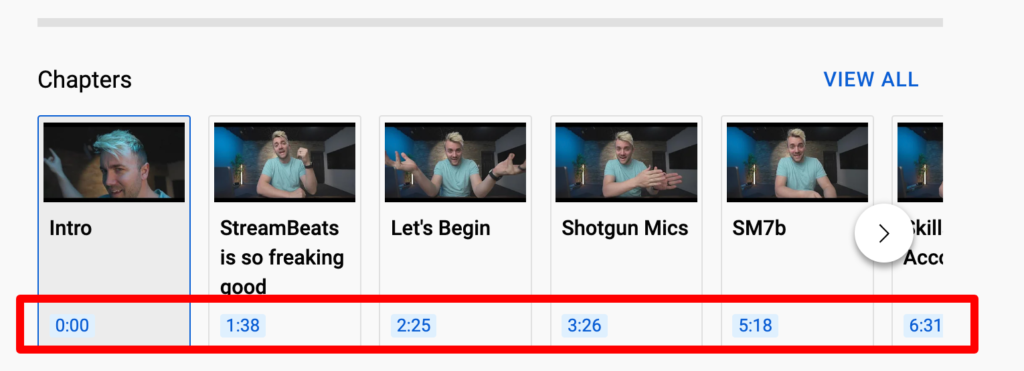
Save your video and the chapters will appear on the timeline. The timestamps will also become clickable links in your description automatically.
This is important: chapter titles aren’t just labels. They’re crawlable text that YouTube and Google use to understand what each section is about. Write them the way you’d write a headline: descriptive, specific, and keyword-relevant where it makes sense naturally.
How to add YouTube chapters automatically
YouTube can generate chapters automatically based on its analysis of your audio and video content. Enable this in YouTube Studio when uploading or editing a video.
The chapters YouTube Studio generates are imprecise and aren’t written with your keywords in mind. Don’t trust them. But you can definitely use them as a starting point. At the very least, they help with the most time-consuming part of chaptering your YouTube video, which is scrubbing the timeline to find chapter breaks. Be sure to check the chapter timings that YouTube suggests.
Chapters you manually enter into the description field will take precedence over YouTube’s auto-generated chapters.
How to add chapters with TubeBuddy
Adding chapters manually works fine. But if you’re optimizing multiple videos at once, or you want to be precise about your timestamps without constantly scrubbing back and forth through a video, TubeBuddy’s Chapter Editor makes is the best answer for how to add chapters on YouTube.
The standard workflow for adding chapters means watching your video, pausing, switching to the description box, typing the timestamp and title, switching back, resuming — and repeating that for every section. It gets the job done, but it breaks your focus and adds up across a backlog of videos.
Chapter Editor puts your video and your chapter list in the same view. Watch, mark a chapter point, add a title without changing tabs or losing your place in the video. It also makes editing existing chapters significantly easier, which matters when you’re going back to optimize older uploads.
Chapter Editor is available for all TubeBuddy licenses and is part of TubeBuddy’s broader upload optimization workflow (the same toolkit that handles keyword research, A/B testing for thumbnails and titles, and bulk editing across your entire library.) If you’re spending real time on YouTube, this is the kind of tool that pays back its cost in minutes saved per upload.
Start adding chapters faster with TubeBuddy →
Get an unfair advantage on YouTube
Give your YouTube channel the upper hand and easily optimize for more views, more subs, and more of every metric that matters.
FAQ – How to add chapters on YouTube
Yes. YouTube uses chapters as signals to understand your video’s content and structure, which helps it recommend your video to the right viewers. On Google, videos with chapters are eligible for Featured Snippets — specifically the “Key Moments” format — which can appear at the top of a search results page and drive meaningful traffic to your video.
YouTube requires a minimum of three chapters, and the first must start at 0:00. There’s no set maximum, but most creators use five to ten chapters for a 10–15-minute video. More chapters aren’t always better — they should reflect genuine content breaks in your video, not arbitrary timestamps added just to hit a number.
Yes. Open any existing video in YouTube Studio, go to the description field, and add your timestamps. YouTube will apply the chapters to your live video within a few minutes. Going back and adding chapters to older how-to and tutorial content is one of the simplest optimization projects you can tackle on an existing library.
Manual chapters are timestamps you write yourself in the video description. Automatic chapters are generated by YouTube’s AI, which analyzes your content to identify natural section breaks. Manual chapters give you control over the titles — which matters for SEO — and tend to be more accurate. They’re the better option for most creators who care about optimization.
Timestamps use the format MM:SS for videos under an hour, or H:MM:SS for longer content. The first chapter must be 0:00. Each timestamp needs a title, and chapters must be listed in chronological order. Chapters won’t appear on your video if the formatting is incorrect, so double-check before saving.


