


 Watch video








 Sign in with Google
Monetization
How many videos does it take to get 1,000 subscribers on YouTube?


TL;DR – How many videos to get 1,000 subscribers on YouTube
- Only about 1 in 10 YouTube channels will ever reach 1,000 subscribers. The ones that succeed are the ones that stick with it.
- There’s no magic number of videos required to hit 1,000 subscribers on YouTube but consistent, iterated output over time is the key.
- Topic selection matters more than posting volume: one well-targeted video can outperform 50 generic ones
- The compounding effect is real: videos posted a year ago may still be earning subscribers today
- Success on YouTube is achievable. The creators who get there are the ones who keep at it, iterate, and learn
If you Googled “how many videos to get 1,000 subscribers on YouTube” and found yourself here, we’re going to assume that what you really want to know is: will this whole “being a content creator” thing actually pay off? And when?!
We’ll give it to you straight: If you put in the work on YouTube, you will succeed. We’ve got the data to back that claim up. If you put in the work and use TubeBuddy, you’ll succeed faster. But either way, your work is not wasted effort. You’ll get there.
Now, to answer “how many videos to get 1,000 subscribers on YouTube?” more directly: there is no magic number. Let’s say it takes 50 videos to get 1,000 subscribers. Does that feel like too much? It’s a lot… but maybe it’s just enough to really find your niche, to make mistakes, to learn, and refine your early processes.
The channels that reach the 1,000 subscriber mark don’t all get there the same way. But what they do have in common is a pattern of behavior, a way of thinking about content, and the stamina to keep at it long enough for all their hard work to compound.
Understanding that pattern is more valuable than any stat, and it’ll keep you from falling into the traps that can stop your YouTube channel from growing.
This post breaks down what the data actually shows, what variables matter most, and why the creators who make it aren’t necessarily the most talented ones. They’re usually the ones who figured out what to make and kept on making it.
Table of contents
- TL;DR – How many videos to get 1,000 subscribers on YouTube
- What the data actually says
- Topic quality matters more than video count
- How your niche affects the timeline
- Evergreen vs. trending content
- How to benchmark your own progress
- Mindset matters on YouTube (well, everywhere… but we’re talking about YouTube)
- FAQ – How many videos does it take to get 1,000 subscribers on YouTube?

What’s the big idea?!
Get video inspo backed by data. Next Video Ideas analyzes your channel, audience, niche, and millions of YouTube datapoints to make your next video a #1.
What the data actually says
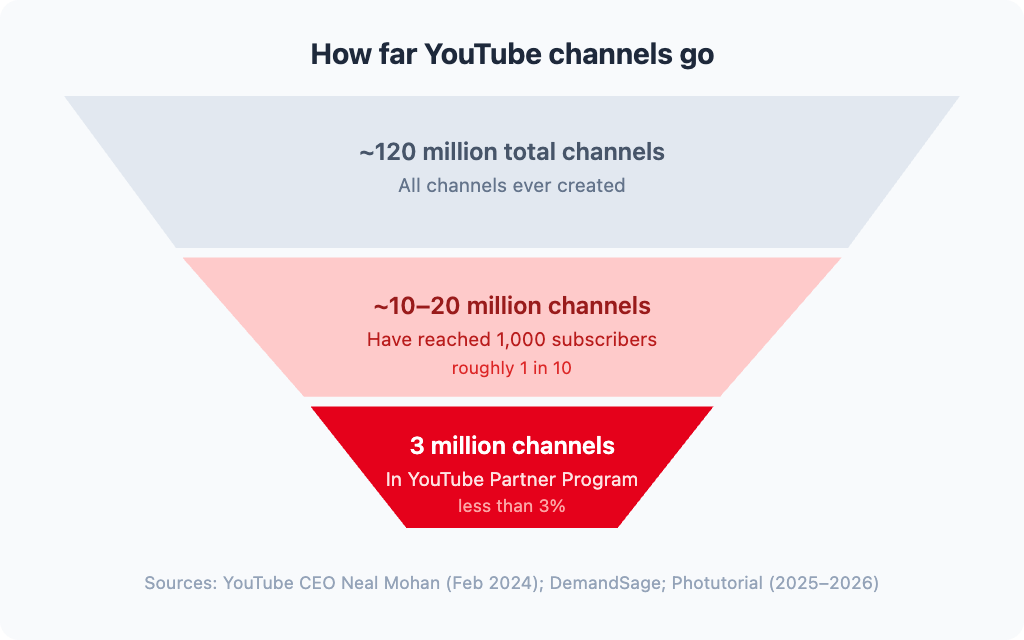
Only about nine to 17% of active YouTube channels ever cross 1,000 subscribers. Whether you believe DemandSage’s numbers from Jan 2026 or Photutorial’s from Feb 2025, that’s pretty daunting. Until you realize most of the channels in that denominator stopped posting within their first year. They didn’t try and fail. They quit.
Let’s look at MrBeast. In September 2023, he posted a tweet sharing his subscriber count year by year. It took him five years to hit 1,003 subscribers. The most-subscribed creator on the planet spent years working toward the same threshold you’re chasing right now. Fortunately, it won’t take you anywhere near as long… but we’ll get to that.
YouTube confirms the scale of the opportunity at the top: about 3 million channels are in the YouTube Partner Program out of somewhere around 115 million channels. Less than 3%..
“How many videos…” assumes the number of videos is the key variable. It’s not. Quality, niche fit, consistency, and iteration determine success or failure. You can publish 100 videos nobody’s looking for and struggle, or you can publish 10 that hit a topic viewers are interested and flourish.
Topic quality matters more than video count
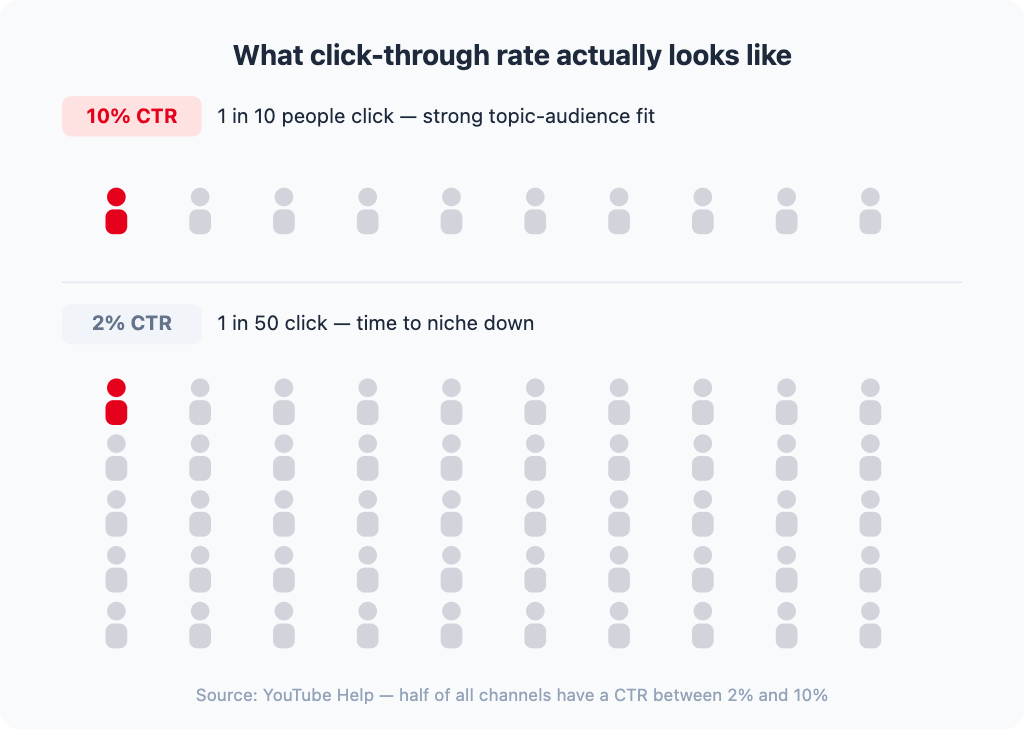
YouTube benchmarks show that half of all channels have a click-through rate between 2% and 10%. That’s a pretty wide range; the difference between 1 person in 50 and 1 person in 10 clicking. So let’s think about the behavior: if you can get 1 in 10 people to click, that’s a pretty good indication you know who your video is for. We can assume you’ve found a niche and you’re serving it well. 1 in 50 means you’re getting some attention but your video is not an obvious click; you should probably niche down. A high CTR means the title and thumbnail frame the topic in a way viewers can’t ignore. A low CTR says the opposite.
Every view on YouTube starts with an impression. The platform shows your video to a potential viewer in Search, Browse, or Suggested and that viewer either clicks or doesn’t. If your video isn’t being surfaced in the first place (low impressions) there’s no way it’s going to get clicks. Videos only get surfaced reliably when YouTube has evidence they’ll satisfy a real viewer need.
A video targeting a real search query — with a title that clearly communicates the value — earns impressions. A poorly targeted video or a video targeting a broad or unfocused topic doesn’t. Production quality, effort, or how long the creator spent editing are moot, unless you’re getting impressions.
Two channels posting at identical frequency can have wildly different growth rates for this reason. One focuses on giving the algorithm evidence that its content satisfies demand. The other is adding volume without signal. The first might find it only takes 20 videos to reach 1,000 YouTube subscribers. The second might give up after 20 videos because they’re not seeing results.
The short version is this: do the YouTube keyword research. Follow every step of the YouTube checklist to make sure your video is one people are searching for. Before you hit record. Before you write your script.
TubeBuddy’s Keyword Explorer helps creators find topics with real search demand at a competition level that’s realistic for their current channel size. A new channel with 200 subscribers competing for a keyword where the top results are 500K-subscriber channels isn’t going to rank. You need to find the right-sized opportunity for your channel and you need to target your content to the opportunity better than anyone else.
How your niche affects the timeline
The fastest-growing YouTube categories in 2025 included video podcasts, gaming crossovers, sports commentary, and education and tutorial content, based on AIRmedia’s review of over 3,000 channels.
General lifestyle vlogging and broad gaming content, for example, rack up 10s of millions of views every day. But they’re crowded. With so many creators vying for attention, you need to find a way to stand apart. You need an angle; something that differentiates your content and makes it valuable. A reason for YouTube to recommend your content and a reason for people to click when it does.
You need to niche down.
The fastest path to 1,000 subscribers is to carve out a niche where you understand the audience well enough to make content that’s better than what’s already out there.
Evergreen vs. trending content
To reach the 1,000 subscriber mark in as few videos as possible, every video you create needs to push you toward that goal. The longer it does so, the better. Evergreen YouTube content keeps working long after you’ve moved on to your next uploads. Your efforts compound. The charts (views, subscribers, channel watch time…) move steadily up and to the right. By contrast, trend content is more volatile. You might be able to catch a wave but it doesn’t last. The charts look spiky instead of steady.
In short, with evergreen content, your numbers are as good as your library. With trending content, you’re only as good as your last upload.
But evergreen content is not entirely “set it and forget it.” You need to monitor it; if impressions, views, and/or watch time starts dropping off on any of your evergreen content, you need to take action. A new title, thumbnail, and a retargeted description can help. TubeBuddy’s A/B testing lets creators test title and thumbnail variants on live videos.
How to benchmark your own progress
Taking inspiration, cues, or lessons from other creators is one thing. Comparing yourself based on subscriber numbers alone is another thing entirely. Don’t do that.
The right metric for early-stage YouTube creators is subscribers per 1,000 impressions. It’s a leading indicator. This is how well you’re converting discovery into subscriptions. A rising rate over 30 to 90 days means you’re doing the right things, even if the absolute numbers are still small.
Find subscribers per 1,000 impressions on YouTube
It takes a bit of digging, but subscribers per 1,000 impressions it’s the best signal available to a channel that has fewer than 1,000 subscribers.
- Open YouTube Studio
- Go to Analytics and select the Audience tab
- Click “How you got your subscribers”
- Cross-reference with the Reach tab for impressions data
Look for a rising subscribers-per-impression rate over time. Flat or declining means something needs to change. Typically, it’s the topic angle, the title framing, or both.
See our full breakdown of how to interpret YouTube analytics for small channels, especially if your channel has fewer than 1,000 subscribers
TubeBuddy’s analytics tools surface which specific videos are driving the most subscriber conversions across your channel, which makes it easier to see what’s working. When you see the pattern, you’ll start to understand what earns you subscribers.
Do more of that!
Mindset matters on YouTube (well, everywhere… but we’re talking about YouTube)
If you searched “how many videos does it take to get 1,000 subscribers on YouTube,” what you really want to know is when will all this hard work pay off? Or if you’re earlier in your creator journey: “is it even worth trying?”
The answer to all the above questions is yes. And to answer your next question: also yes, we do realize that only one of those three questions had a binary answer.
The work will pay off. You will succeed on YouTube if you stick with it, learn, and iterate — if you look at is as a discipline. You will probably not succeed if you toss a bunch of stuff out there and wait for YouTube and viewers to decide it’s your turn to be a star — if you look at is as a lottery.
The creators that quit almost always do so in the plateau between videos 20 and 50. In this 30 video morass, the grind is most apparent and the results are least proportional. In our experience, it’s also the window just before things start to shift for the channels that break through.
Slow growth doesn’t mean your content sucks. It’s probably just one of two things: the topic angle isn’t clicking — or at least, hasn’t yet found the right audience — or the content is reaching people but not convincing them to subscribe.
Learn, iterate, repeat. That’s it.
The creators that succeed on YouTube are the ones who worked at it long enough to find out who their audience is and what they respond to, and leaned in to that.
We’re not saying it’s easy. YouTube is competitive. It takes patience, and it takes work. But for creators who find their niche and do the work, it’s not a question of if. It’s a question of when.
If you do the work on YouTube, you will succeed. If you do the work on YouTube and use TubeBuddy, you will succeed faster.
And once you do hit 1,000 subscribers and cross the 4,000 watch hours threshold, the monetization upside might surprise you. TubeBuddy’s YouTube revenue calculator lets you estimate what your channel could realistically earn based on your niche and view count. It’s a useful reminder that the finish line is worth reaching.
What’s the big idea?!
Get video inspo backed by data. Next Video Ideas analyzes your channel, audience, niche, and millions of YouTube datapoints to make your next video a #1.
FAQ – How many videos does it take to get 1,000 subscribers on YouTube?
There’s no single answer — timelines range from a few months to several years, depending on niche, posting frequency, and how well topics match what viewers are searching for. MrBeast himself spent roughly three to four years reaching his first 1,000 subscribers before eventually becoming the most-subscribed creator on the platform. The more actionable question is whether your subscribers-per-impression rate is trending upward — that’s the real signal of momentum.
Frequency helps, but only when it’s paired with topic quality. More videos means more discovery opportunities — but only if those videos target topics people are searching for and clicking on. Posting more of the same underperforming content won’t change your trajectory. Posting more well-researched, audience-targeted content will.
Search-optimized, evergreen content in niches with real audience demand and manageable competition tends to grow the fastest and most durably. Categories showing strong growth in 2025 include video podcasts, education and tutorial content, and niche sports commentary (AIR Media-Tech). The key is combining consistent output with deliberate topic research — and optimizing titles and thumbnails to earn the click once the video is in front of the right audience.
Views mean YouTube is surfacing your content — that’s the hard part, and you’ve done it. If viewers aren’t subscribing, the most common causes are a lack of clear channel identity (viewers aren’t sure what they’d be subscribing to) or a mismatch between what the title and thumbnail promised and what the video delivered. Check your subscribers-per-1,000-impressions metric in YouTube Studio; if it’s low, that’s the number to move.
It can happen, but it’s uncommon and not a reliable strategy. Viral growth often attracts an audience that isn’t aligned with the channel’s regular content, which means high churn after the spike. Sustainable growth comes from consistent, targeted content that attracts the right audience repeatedly — not just once.


